EYE LASER TREATMENT
Ray-Tracing Laser Correction
With Ray-Tracing, your laser treatment is designed from a digital 3D model of your whole eye – not just from your glasses prescription. We calculate how light travels through your eyes and create a laser profile that is unique to you. The treatment can be performed as LASIK or as a surface treatment.
Personal laser profile
As LASIK or surface treatment
6-year Peace of Mind Guarantee
See how Ray-Tracing works
Ray-Tracing Laser Correction with InnovEyes
From glasses prescription to the optics of the whole eye
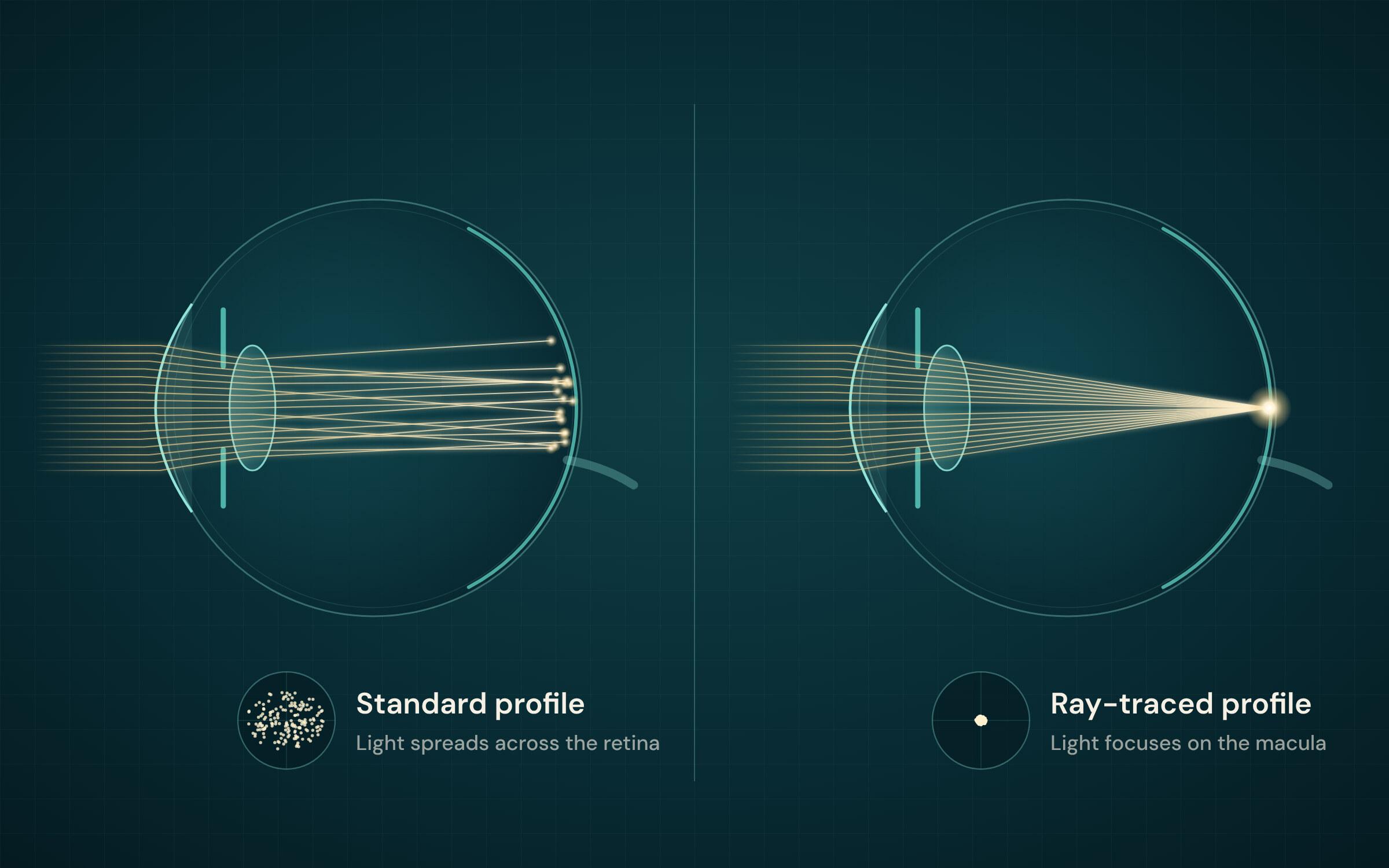
A conventional laser treatment is based mainly on your glasses prescription and on a standard model of the eye. But no two eyes are built the same. The shape of the front and back of the cornea, the properties of the lens and the length of the eye all affect how light finally reaches the retina.
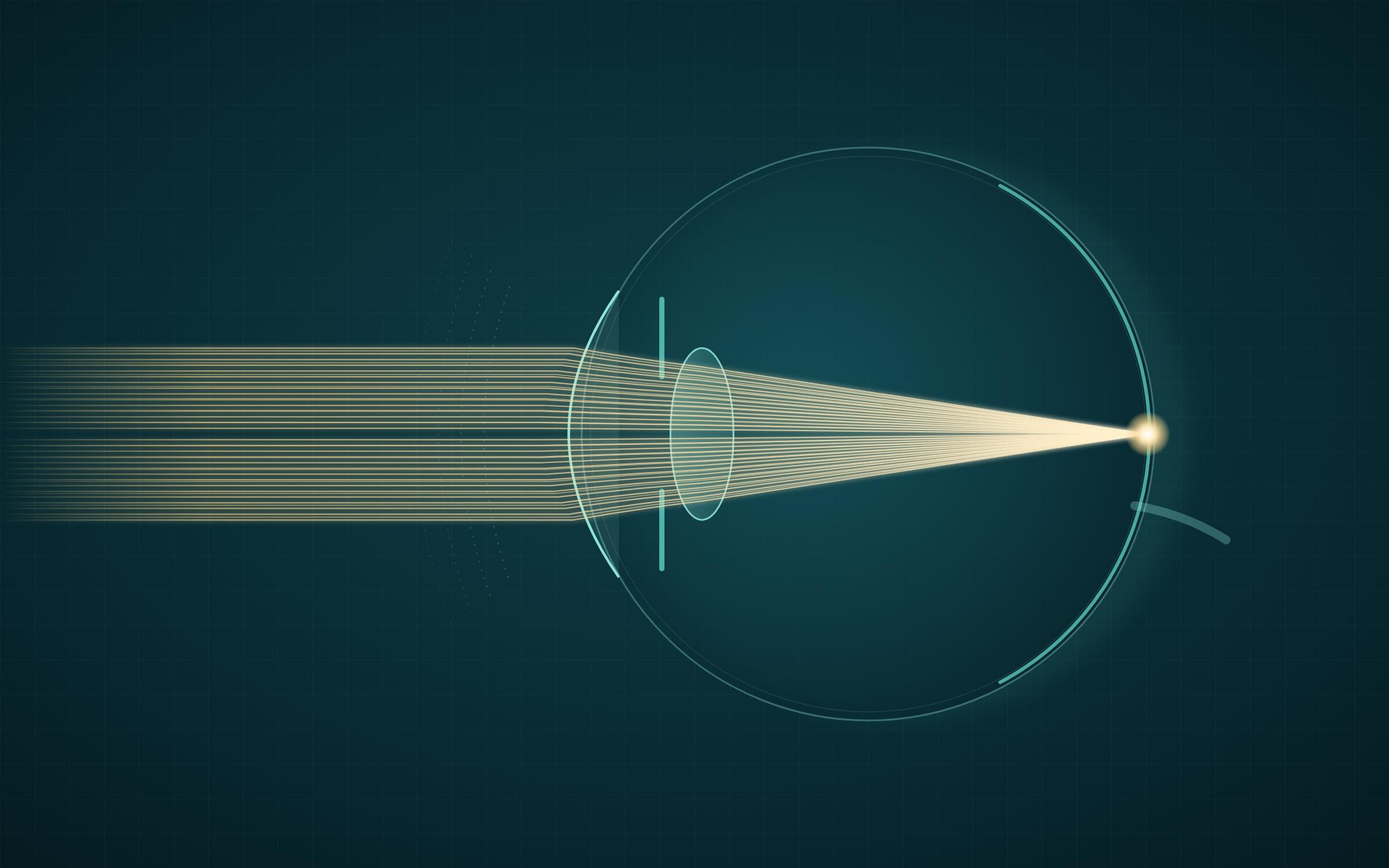
Ray-Tracing is a calculation method from the world of optics. Software follows thousands of simulated light rays through a 3D model of your own eye and refines the laser profile step by step, until the light comes to as sharp a focus as possible on the macula.
Two people with the same glasses prescription can therefore receive completely different treatments – because the optics of every eye are unique.
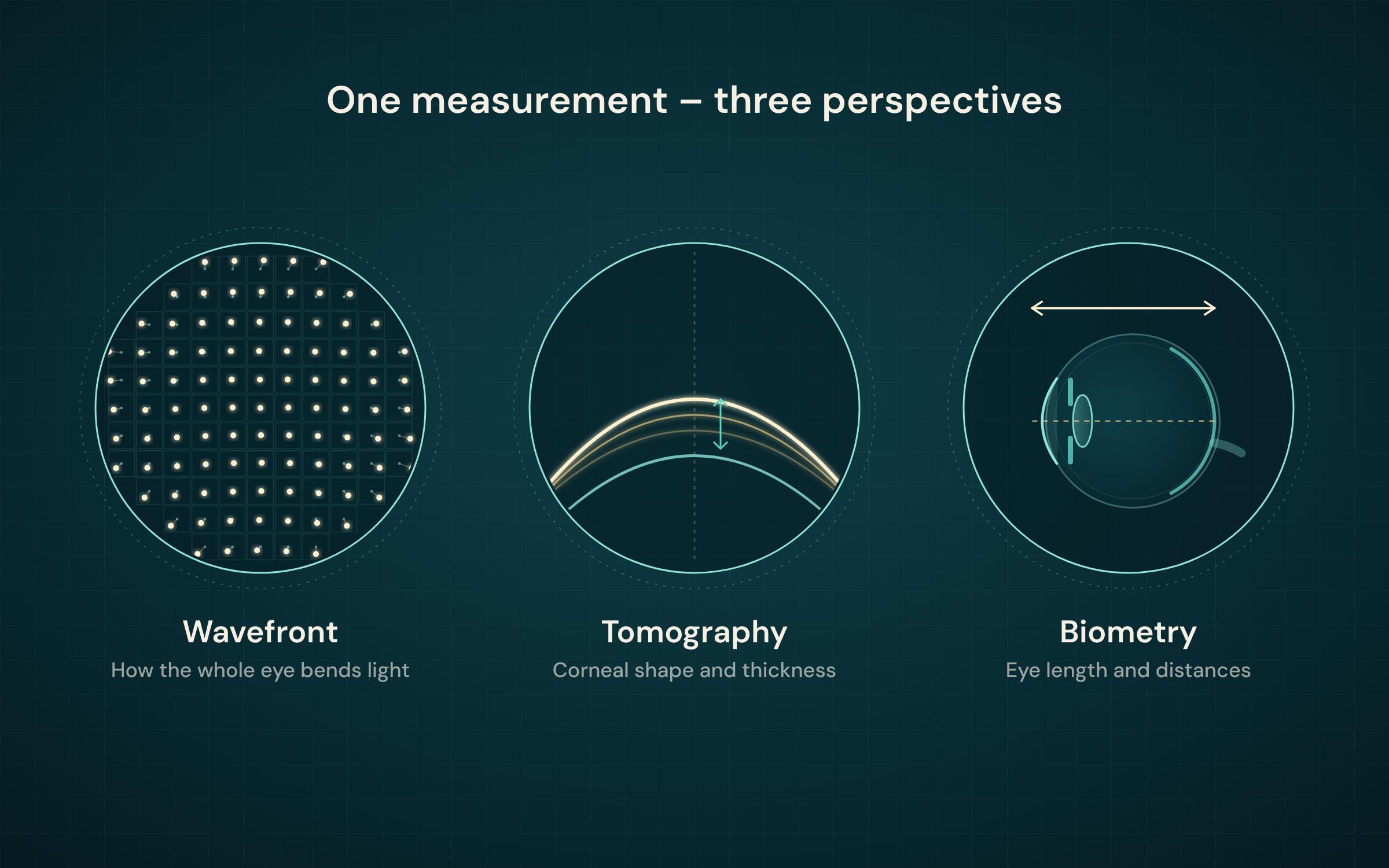
The whole eye measured in a single instrument
At your pre-examination we measure your eyes with the InnovEyes Sightmap from Alcon. The instrument combines three types of measurement in one examination:
Wavefront analysis – shows how the whole eye bends light, including the small optical irregularities that glasses cannot correct.
Scheimpflug tomography – maps the front and back surfaces of the cornea and its thickness.
Biometry – measures the length of the eye and the distances between its optical components.
Because everything is measured at the same time and in the same position, the measurements fit together precisely. That is the foundation of a reliable 3D model.
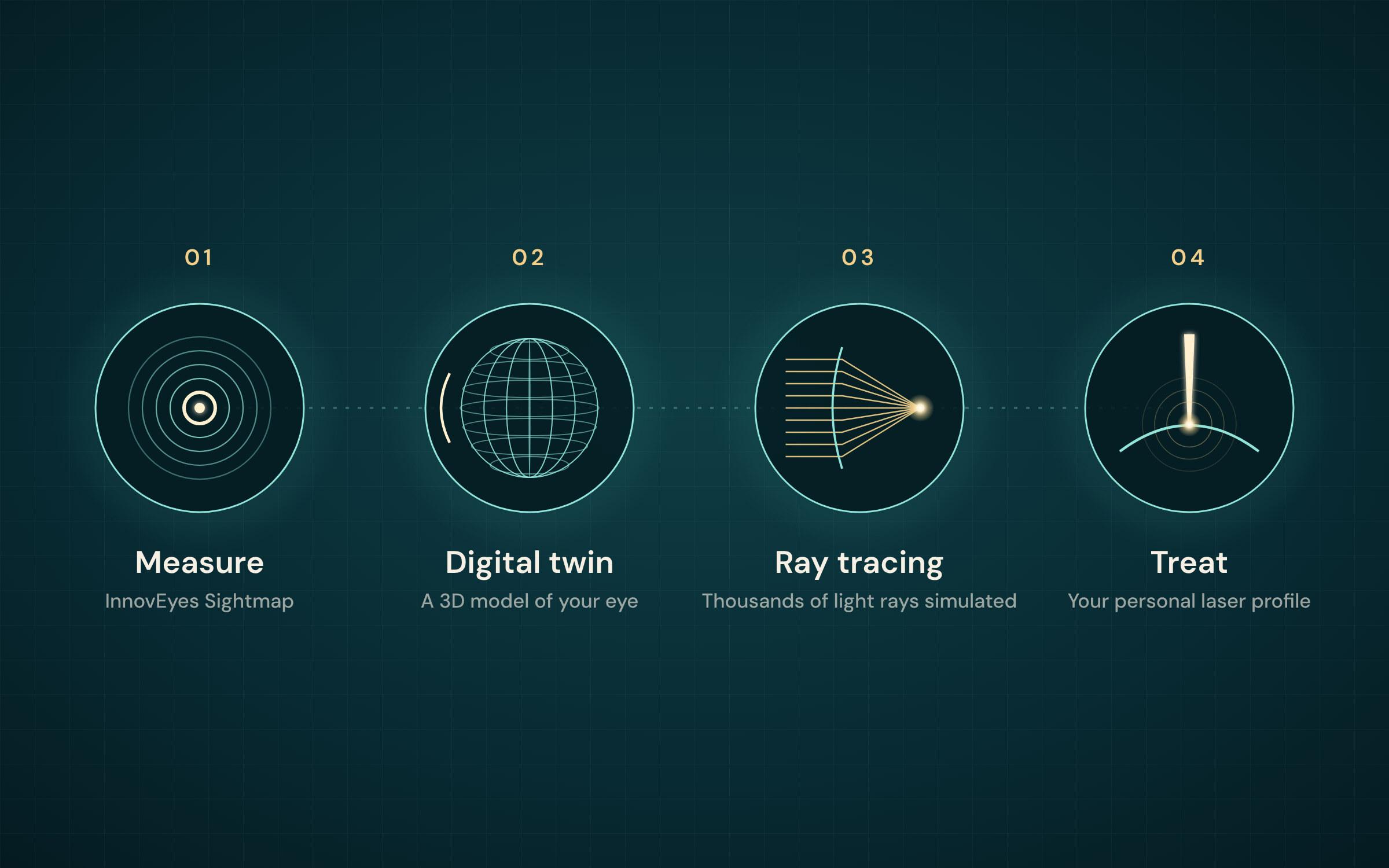
Your treatment is tested virtually before it is performed
The measurements are used to build a digital twin – a personal 3D model of your eye. In the model, thousands of light rays are simulated as they pass through the cornea and lens towards the retina.
The software calculates where each ray lands, adjusts the planned laser profile and recalculates – again and again – until the rays converge as tightly as possible on the macula. Only then is the treatment plan complete.
Your eye surgeon reviews and approves the plan before the day of treatment.
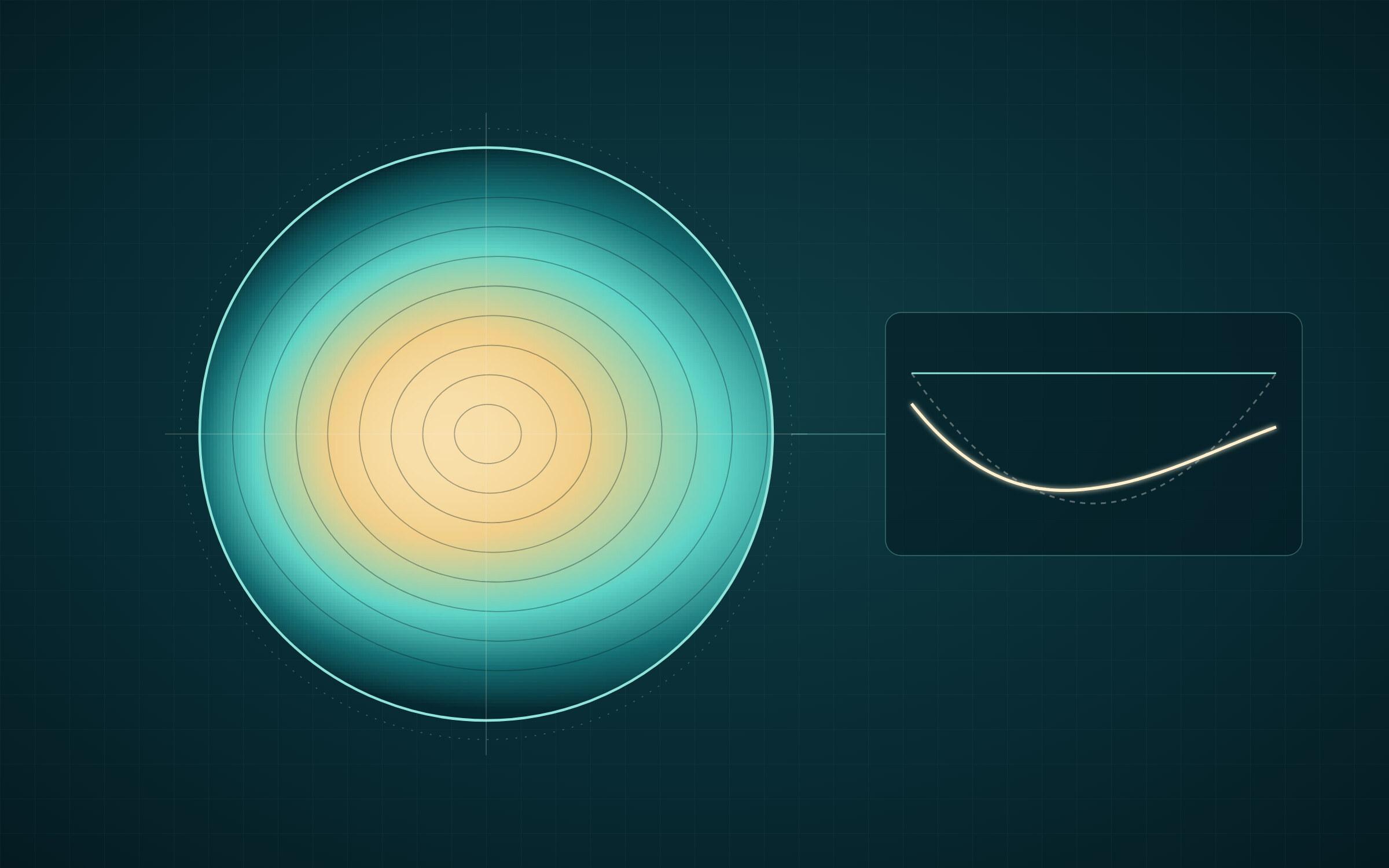
A laser profile that fits only your eye
The result of the calculation is a personal laser profile – an exact map of how much tissue is to be reshaped at every point of the cornea. The profile is transferred to the Alcon WaveLight EX500 excimer laser, which performs the treatment with a fast eye tracker that follows the movements of your eye throughout.
The goal is not just sharp vision on the eye chart, but the highest possible quality of vision – with good contrast and fewer light phenomena in the dark.
LASIK or surface treatment – the same personal profile
Ray-Tracing describes how your treatment is planned. The laser profile itself can then be applied in two ways, depending on what suits your eyes best:
As LASIK – the ZEISS VisuMax 800 femtosecond laser creates a thin flap in the cornea, and the personal profile is applied beneath the flap. Fast recovery, and usually good vision the very next day. Read more about FS-LASIK.
As a surface treatment – the profile is applied directly to the surface of the cornea, without a flap. Healing takes a few days longer, but the cornea keeps more of its strength. A good choice for thinner corneas or if you play contact sports. Read more about LASEK.
Which option suits you is something we decide together at the free pre-examination, based on factors such as corneal thickness, your tear film and your lifestyle.
What do the studies show?
Ray-Tracing with InnovEyes has been studied in several clinical trials, mainly in LASIK for nearsightedness with or without astigmatism. In the study behind the US Food and Drug Administration (FDA) approval in 2025, three months after treatment:
92% of eyes had 20/20 vision or better without glasses
67% had 20/16 vision or better
92% had a remaining refractive error within ±0.50 dioptres
In a twelve-month follow-up (Krueger et al., Clinical Ophthalmology 2026), 94% of eyes had 20/20 vision or better, and 98% of patients were completely or very satisfied with their vision.
These results apply to groups of patients. What you can expect depends on your own eyes, and we go through that with you at the pre-examination.
Who can be treated with Ray-Tracing?
Ray-Tracing is used to correct nearsightedness, with or without astigmatism. It suits you if you:
are between 20 and 45 years old and your glasses prescription has been stable for the past year
have healthy eyes without corneal disease
want a treatment planned from the optics of your whole eye
If you are farsighted, have very thin corneas or pronounced dry eye, another method may suit you better – for example SMILE Pro or No-Touch Trans-PRK. We always recommend the method that is best for your eyes.
All our vision correction treatments include our 6-year Peace of Mind Guarantee.
Frequently asked questions about Ray-Tracing laser correction

How is it different from a standard laser treatment?
A standard treatment is based mainly on the glasses prescription and a standard model of the eye. With Ray-Tracing we build a 3D model of your own eye and calculate the laser profile from how light actually travels through your cornea and lens. The treatment is therefore more personally tailored.
Should I choose LASIK or surface treatment?
Both use the same personal laser profile. LASIK offers the fastest recovery, while surface treatment preserves more of the cornea's strength and may suit thinner corneas or contact sports better. We recommend an option after your pre-examination.
Does the treatment hurt?
The treatment is performed under anaesthetic eye drops and is not usually painful. After LASIK a mild gritty feeling during the first 24 hours is common. After surface treatment the eyes may be sore and sensitive to light for a few days, which is relieved with drops and painkillers.
How long does the treatment take?
The laser treatment itself takes only a few minutes per eye. Expect to be with us for a few hours on the day of treatment, including preparation and a check-up afterwards.
Can I see better than with glasses?
Many people achieve vision at least as good as with glasses, and in the studies some patients gained best-corrected vision compared with before treatment. A specific result can never be promised, however – at the pre-examination we tell you what is realistic for your eyes.
Is the Peace of Mind Guarantee included?
Yes. Our 6-year Peace of Mind Guarantee covers the refractive correction: if a refractive error remains or develops after your first treatment, we offer additional laser treatment at no extra cost within six years. Read more about the Peace of Mind Guarantee.
Contact us – we'll help you find the right treatment
Which treatment suits your eyes? Tell us briefly what you would like help with and we will get in touch. Our experienced specialists answer your questions and guide you to the treatment or examination that fits your needs.
X-Vision Ögonklinik
Hyllie Stationstorg 2
215 32 Malmö